Electrophysiology of ECG
To be able to understand the ECG rhythms properly, we need to understand electrophysiology of ECG and get oriented to the origin and propagation of the pacemaker potential (voltage) that drives the heart automaticity.
Electrophysiology of ECG
Heart has a few specialized areas (muscle cells) that can generate voltages at a particular frequency called as pacemakers. The generated voltage spreads to rest of the heart muscle and leads to contraction.
Pacemakers in the heart:
– SA node – Sino-atrial node (Primary)
– AV node – Atrio-ventricular node
– Bundle of his
– Even the ventricular muscle can act as one.
Though there are more than one pacemaker in the heart, only one of them drives the heart pumping. Whichever pacemaker can generate potentials at a faster rate will be in charge of heartbeat. Usually, it is the SA node which is called as primary pacemaker that has a rate of 60-100 beats a minute.
The AV node has a frequency of 40-60 beats a minute.
The bundle of his has a frequency of below 40 beats per minute.
By this logic, if SA node fails, as AV node has higher frequency than bundle of his, it will be in control of the heart rate. That means the ventricles will have a heart rate of 40-60 beats per minute.
Similarly, if SA and AV nodes fail, bundle of his will drive the heartbeat at a rate of 30-40 beats a minute and the ECG will have wide QRS complexes.
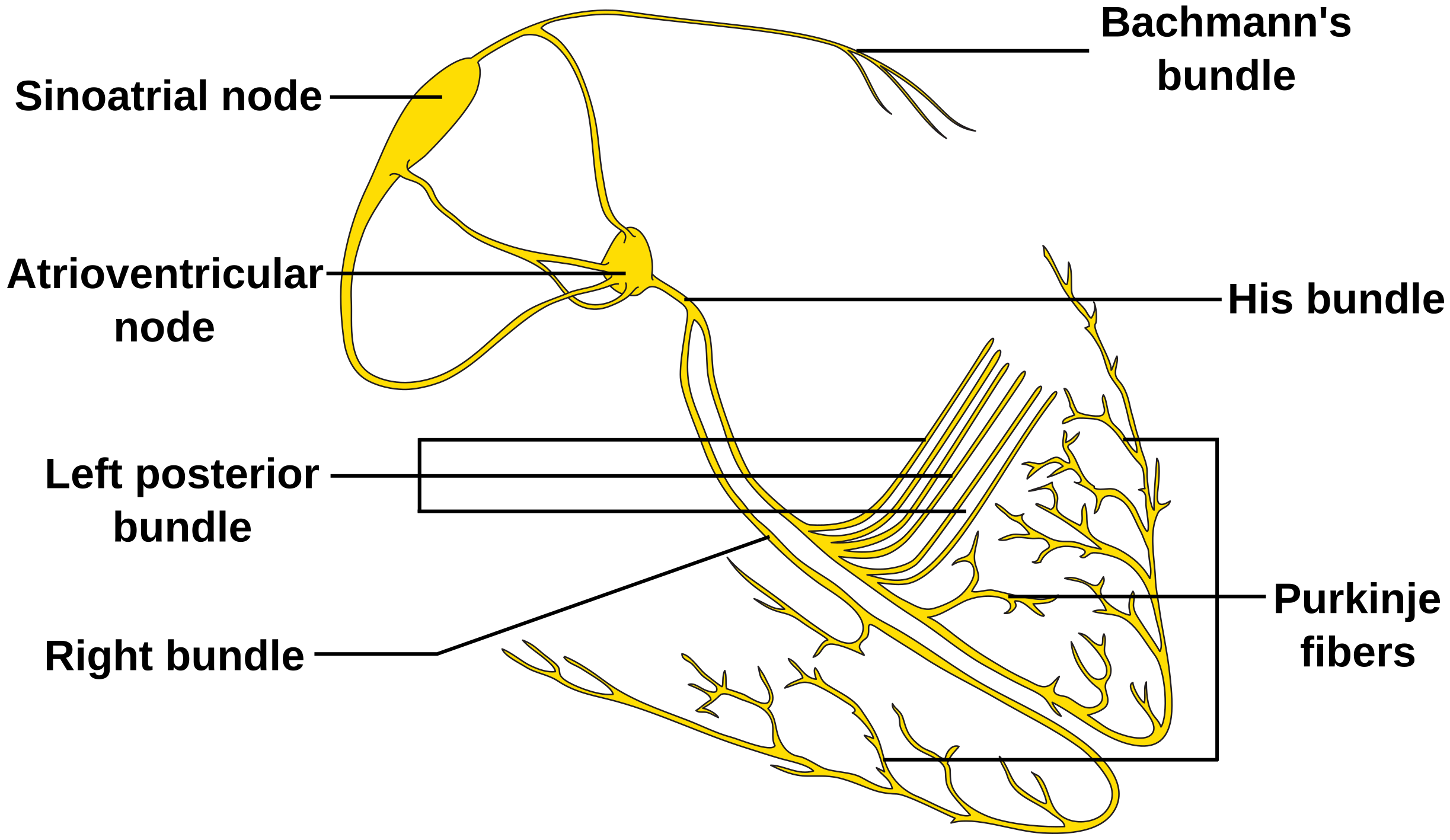
Conduction system of the heart : Credits-By Madhero88 (original files); Angelito7 (this SVG version); – ConductionsystemoftheheartwithoutHeart.svg, CC BY-SA 3.0, https://commons.wikimedia.org/w/index.php?curid=29922595
As long as the pacemaker potentials are coming from AV node or above, the ventricular contraction will produce a narrow complex wave form on ECG. If you see wide complexes on ECG, that means the origin of the potential is below the AV node.

By Drricksanchez – Own work, CC BY-SA 3.0, https://commons.wikimedia.org/w/index.php?curid=28992039
The ECG complex. P=P wave, PR=PR interval, QRS=QRS complex, QT=QT interval, ST=ST segment, T=T wave
As the potential originates from SA node, it propagates to atria and AV node, then bundle of his, then purkinje fibers and finally to ventricular muscles.
Atrial contraction is seen on ECG as “P” wave.
Ventricular contraction is seen as “QRS” complex and ventricular relaxation is seen as “T” wave.
Atrial relaxation is not visible on ECG as it’s small and occurs during ventricular contraction where the ECG is recording “QRS” complex.

By Kalumet – selbst erstellt = Own work, CC BY-SA 3.0, https://commons.wikimedia.org/w/index.php?curid=438152
AHA ACLS expects you to identify the following rhythms and manage them when the need arises.
– Normal sinus rhythm
– Atrial fibrillation
– Atrial flutter
– Bradycardia
– Tachycardia
– Asystole
– Pulseless electrical activity (PEA)
– AtrioVentricular blocks (1st, 2nd, 3rd degree heart blocks)
– Ventricular tachycardia
– Ventricular fibrillation
We’ll go through each rhythm in the next lessons.